
Balancing AI Assistance and Cognitive Agency
AI Reliance Linked to Lower Thinking Confidence
New research suggests passive AI use creates "cognitive debt" while active engagement preserves intellectual agency.
A person sits at a desk in a dark room, looking thoughtfully at a glowing blue digital brain visualization hovering above a laptop screen.
Photo: Kronos Digital News
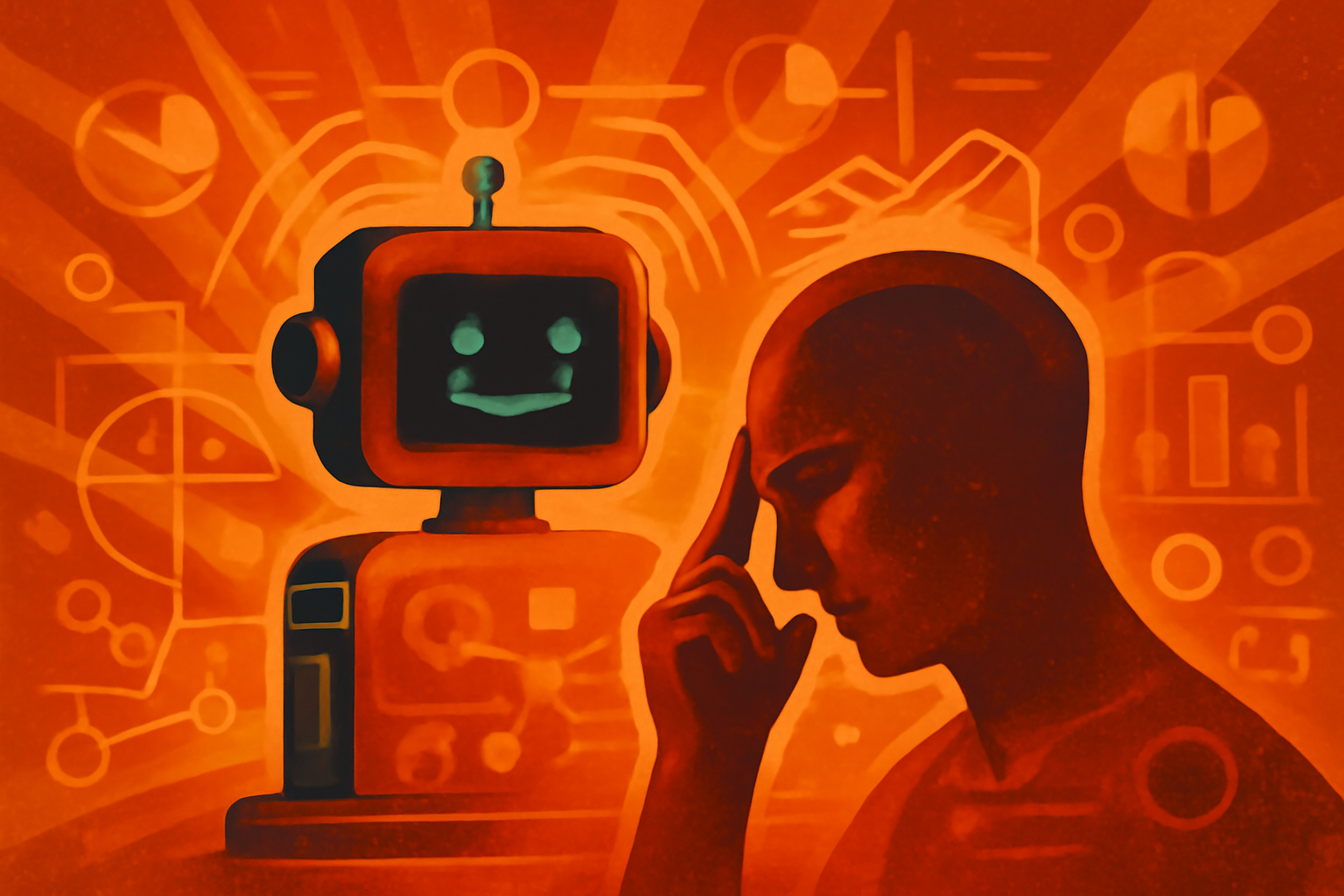
A peer-reviewed study shows that outsourcing intellectual tasks to AI chatbots can lower self-confidence in reasoning abilities [1][3]. Researchers found that passive adoption of AI answers leads to what they call "cognitive debt" [1]. This effect is most pronounced when users stop questioning the logic behind AI-generated responses [2]. The research highlights a distinct difference between passive use and active engagement [1][2]. Users who critically evaluate and question AI output maintain a stronger sense of ownership over their work [1][2]. This active approach helps preserve intellectual agency even when utilizing advanced digital tools [3]. Experts suggest that overreliance on these systems may eventually erode a user's belief in their own problem-solving skills [1]. To mitigate this risk, researchers recommend using AI as a collaborator rather than a replacement for critical thinking [2].
Editorial notes
Transparency note
Drafted with LLM; human-edited
- AI assisted
- Yes
- Human review
- Yes
- Last updated
Risk assessment
Reviewed for sourcing quality and editorial consistency.
Sources
Related stories
View all

Topics
About the author
Kronos Digital News Desk covers balancing ai assistance and cognitive agency and editorial analysis for Kronos Digital News.